


If you are asking what to do if rehab is not helping, start with a conversation, not a sudden exit. Feeling stuck can mean the setting, the pace, or the plan needs another look. It does not mean you failed, and it does not mean you should stop care on your own. The useful next step is to name what feels wrong, ask about safety and fit, and let a clinician decide whether the plan should change.
Call (330) 953-3300 to talk through treatment fit. If you prefer to read first, review the admissions process.
New Day Recovery is an adult inpatient program in Niles, Ohio, for men and women age 18 and older. The two levels of care the program provides directly are withdrawal management, also called detox, and residential treatment. A call is a request for a staff-led review. It is not a reserved bed, a promise of same-day admission, or a guarantee that any one program will be the right next step.
Pause before you leave treatment on your own
The hardest moment is often the one where treatment feels pointless. Sleep is poor. Groups feel repetitive. A family member is worried and the person in care wants to go home. Walking out without a plan can leave withdrawal, cravings, and the same stressors waiting at the door.
Do not leave a program on your own because one hard stretch feels like proof that nothing will change. Ask the current team for a reassessment first. If you cannot get that conversation, call a program that can review safety and level of care with you.
The National Institute on Drug Abuse describes substance use disorders as chronic, treatable conditions from which people can recover. NIDA also says treatment can help a person stop or reduce use and help prevent a return to use. A return to use is a signal to resume care, adjust it, or try a different approach. It is not, by itself, proof that treatment failed. For some substances, using a previous amount after a period of abstinence can raise overdose risk because the body is no longer used to that dose. That is one reason a frustrated exit is not a safe plan.
Tell the current care team, in plain words, what is not working. If you are between programs, call admissions and describe the gap. SAMHSA’s National Helpline, 1-800-662-HELP (4357), is a free, 24-hour treatment referral and information service. It does not provide counseling, and it does not place you in a bed. It can point you toward local options while you arrange a direct admissions conversation. You can also text your ZIP code to 435748.
Name what “not helping” actually means
“Rehab is not helping” can describe several different problems. Sorting them out changes the question you ask next. A mismatch is not the same as a medical emergency, and a communication problem is not the same as the wrong level of care.
| What it can feel like | What to ask about | What not to decide alone |
|---|---|---|
| Withdrawal still feels unsafe, or symptoms are getting worse. | Ask whether medical monitoring, a hospital, or a different withdrawal plan is needed. | Do not stop medication, leave detox early, or switch substances to take the edge off. |
| The setting feels too intense, or not intense enough. | Ask whether detox, residential care, or a step-down such as outpatient support is a better fit. | Do not assume a longer stay, a shorter stay, or going home will fix the mismatch. |
| You do not understand the plan, or staff do not seem to hear you. | Ask who explains the plan, how often it is reviewed, and how a concern gets to a clinician. | Do not treat silence as proof that nothing can change. |
| Mental health symptoms are new, severe, or not being managed. | Ask whether this program can support an already managed condition, or whether a referral is safer. | Do not expect every facility to stabilize a new or uncontrolled psychiatric crisis on site. |
| A return to use happened during or after the stay. | Ask what in the plan should change, and what support follows the current level of care. | Do not read one return to use as proof that treatment can never work. |
Write down two or three concrete examples before the call. “Groups do not click” is hard to act on. A clearer note sounds like this: “I leave group more anxious than when I walked in, and no one has reviewed my plan since day two.” That gives a clinician something to assess.
Questions about safety
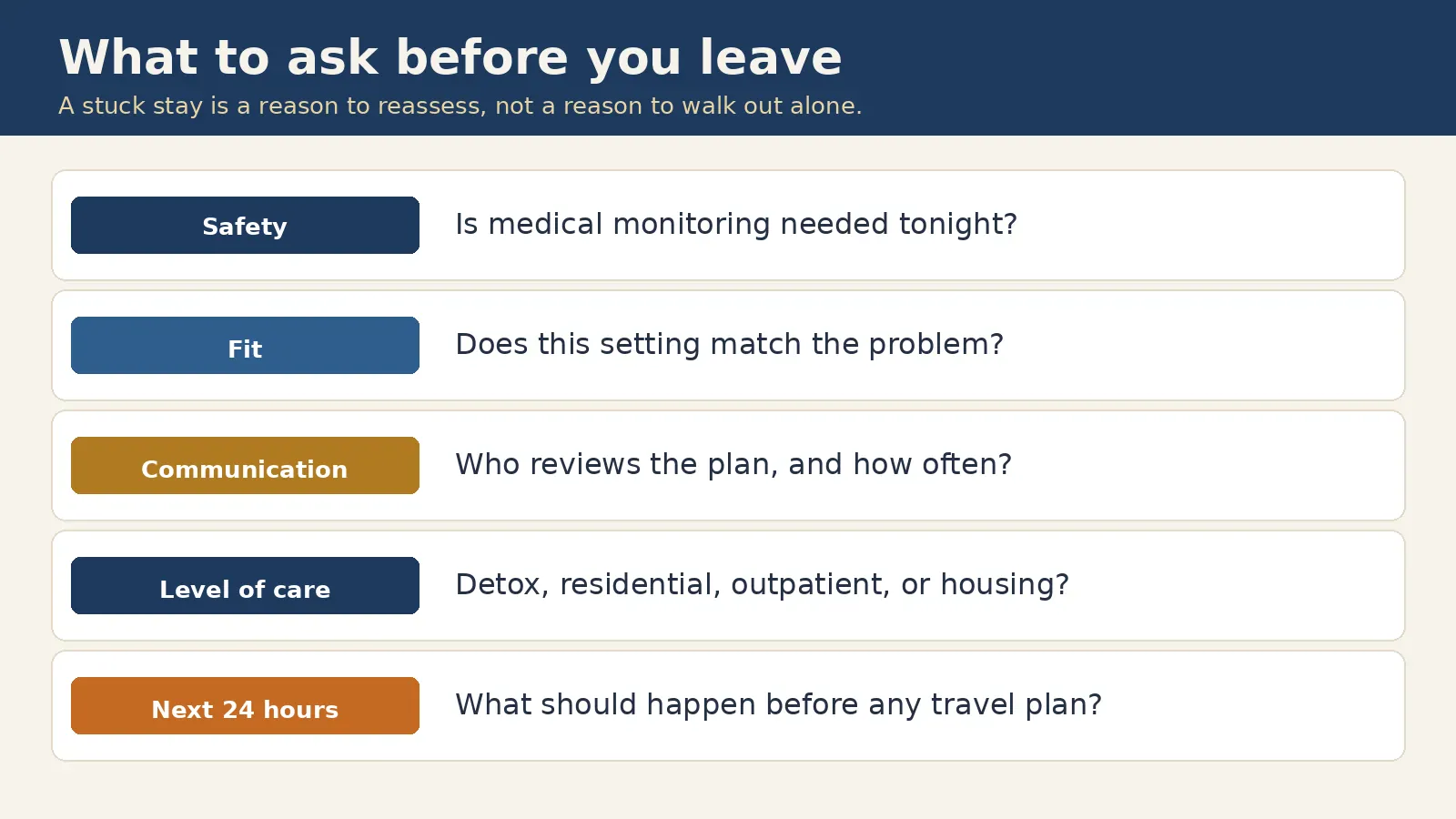
Safety comes before program preference. If someone is in active withdrawal from alcohol or benzodiazepines, or is medically unstable, ask where that person can be monitored. Do not pick a program from an amenity list. Do not try to manage that risk at home because a previous stay was disappointing.
Ask these questions of the current team, or of admissions at the next program:
- What substances are involved, and when was the last use?
- Are there warning signs that need a hospital rather than a residential detox unit?
- Who is watching medical status overnight, and what happens if symptoms worsen?
- Which medicines, if any, might be used, and who decides that after an assessment?
- What should the person do tonight if leaving now would be dangerous?
New Day Recovery’s drug and alcohol detox program is medically supervised withdrawal management for adults. People asking about opioids can also review the opioid rehab page for that substance-specific route. It is an entry point, not a separate facility or a promised bed. Staff may use medication when a clinician decides it is appropriate. That is not a published formulary, and it is not a promise that every medicine used in a past program will be continued.
Alcohol or benzodiazepine withdrawal that needs hospital care should go to a hospital first. Opioid or stimulant withdrawal may be reviewed for New Day’s own detox, then residential care if that is the assessed next step. A hospital transfer is not a permanent referral away from New Day when detox there is the safer first step.
Bring a current medication list, doses, and the name of the prescriber. Do not stop a prescribed medicine because treatment feels unhelpful. A clinician needs that list to judge interaction risk, withdrawal risk, and whether the program can support the regimen.
What to do if rehab is not helping with fit
Fit is about whether this level of care matches the problem in front of you. A short stay that never looked at home stressors can feel empty. A highly structured setting can feel wrong for someone who needed a different kind of support. Neither feeling tells you, by itself, to abandon care.
The page Is inpatient treatment right for me? is written for people deciding whether a structured setting makes sense the first time. Use it as background. If you are already in a program that feels stuck, ask a narrower set of questions:
- What problem was this level of care supposed to address?
- What has been tried inside the stay, and what has not?
- Is the issue the setting, the therapy approach, the length, or something outside the program?
- Would a gender-specific residential track change the day-to-day experience?
- Does the program treat the substance pattern the person actually has?
New Day offers residential treatment for adult men and women at its Niles campus, 1500 McKinley Avenue. Residential treatment is living on site with counseling, skills work, and a plan built after assessment. It is not the same thing as detox, and completing detox does not by itself reserve a residential bed. Men’s and women’s tracks are described separately, so the daily experience is not identical for every adult.
If you are comparing how long to stay, the guide to short-term versus long-term drug rehab covers duration. This article stays on the earlier question: what to ask when the current plan already feels like it is not helping. Length is one variable a clinician may change. It is not the whole answer.
Questions about communication
Many people describe a program as “not helping” when they cannot tell what the plan is. They attend groups, then go home, or back to the unit, without knowing what was supposed to change. Families hit the same wall when they cannot get a clear update and start filling the gap with guesses.
Ask who owns the plan, how often it is reviewed, and how a concern reaches a clinician. Also ask what a family member is allowed to know, and what requires the patient’s permission. Privacy rules exist so treatment details are not shared by default. They are not an excuse for leaving a worried family with no appropriate contact path.
New Day’s family information page publishes the current family-programming description. It says each client may have one family member, age 18 or older, in the educational group and visitation sessions. Those sessions are described as bi-weekly, with men’s family programs on Saturdays and women’s on Sundays. Confirm the current calendar, consent, and the patient’s own preference with staff before you plan a visit. A published schedule is a description, not a promise that every visit will be approved in a given week.
On a call, try this sequence:
- State the person’s age and that you are calling about adult substance use treatment.
- Say whether the person is in a program now, between programs, or just left.
- Name the safety concern first, then the fit concern, then the communication concern.
- Ask what information admissions needs before anyone can talk about next steps.
- Ask what the person should do in the next 24 hours while that review happens.
You do not need a polished script. You do need the facts that change clinical judgment: substances, last use, current medicines, any hospital visits, and whether a mental health condition is already in care with another provider.
Questions about level of care
Level of care is the intensity of support, not a brand name. Withdrawal management, residential treatment, partial hospitalization, outpatient counseling, and recovery housing solve different problems. Switching labels without an assessment is how people end up in a second program that repeats the first mismatch.
A continuum of care overview is useful background for how those stages relate. It is not a ladder every person must climb, and it is not permission to skip a medical assessment. Ask which stage the current struggle actually belongs to:
- If the body is still in withdrawal, the question is medical monitoring, not a new group schedule.
- If withdrawal has eased but home is full of triggers and the day falls apart, ask about residential structure.
- If the person is stable enough to live at home, ask whether outpatient care, or a partner partial hospitalization program, is the honest fit.
- If the person needs a sober place to live after clinical care, ask about recovery housing as housing, not as another inpatient bed.
New Day directly provides adult detox and residential treatment in Niles. Outpatient pages and medication-assisted treatment pages are educational routes. They are not a claim that every medicine is stocked on this campus, and they are not a claim of on-site dual-diagnosis stabilization. The partial hospitalization page describes access through partner organizations. Do not read that page as a New Day-operated PHP unit inside the Niles building. Recovery housing is offered with Valley Recovery Partners, a sister organization. It is a residence arrangement, not a clinical bed, and it is not an automatic step after residential care.
Co-occurring mental health needs the same precision. New Day may consider some conditions that are already being managed with medication and outside providers. It does not claim to stabilize every new or uncontrolled psychiatric diagnosis on site. If that is the gap in the current program, say so. A referral can be the responsible recommendation, not a rejection of the person.
What a reassessment can change, and what it cannot
A good reassessment can change the setting, the schedule, the therapy mix, the family contact plan, or the step that comes next. It can also confirm that the current level of care is still right and that the hard part is staying with it. Both outcomes are useful. Neither is a verdict on your worth.
It cannot honestly promise a cure, a relapse-free year, a specific number of days, or insurance approval before the plan is checked. NIDA’s point is that care can be adjusted over time. That is not a prediction for any one person, and it is not a recovery rate for any one facility. Testimonials you read online are individual stories. They are not a measure of what will happen for you.
If cost or coverage is part of why the current plan feels impossible, separate that from the clinical question. New Day’s admissions team can look at benefits. A no-cost benefits check is not a promise that a plan will pay, and it does not set a copay or a length of stay. The insurance verification page is the place to start that paperwork conversation. Bring the insurance card, the subscriber name, and any denial letter. Do not guess at a dollar amount from a blog post.
CARF lists adult residential treatment and inpatient withdrawal management for New Day Recovery’s Niles location. The About page describes the center as CARF accredited for those services. That listing supports those two program categories. It is not a blanket license stamp on every page of the website, and it does not tell you whether a bed is open today.
How New Day Recovery handles the next conversation
If you want that review with New Day, call (330) 953-3300 or use the homepage contact path. Admissions is built around a staff conversation. The admissions page says the coordinator collects more detail over the next 5 to 10 minutes and that intake appointments can be scheduled for the same day or the next day. Those are process descriptions. They are not a guarantee of a bed, a start date, or a callback at a fixed minute.
Have your questions and the current treatment concern ready for the call, and share only what you choose. Nothing in this article is a privacy certification, and a blog is not the place to send medical details in writing.
What to expect in treatment walks through arrival, paperwork, and assessment for people who do come to Niles. Read it after you know a stay is actually being considered. It will not tell you whether you should leave a different program tonight.
On the phone, ask for a level-of-care review rather than for a sales tour. Useful questions include:
- Does this situation sound like detox, residential care, a referral, or something you do not provide?
- What medical or mental health limits would make Niles the wrong setting?
- If residential care is not the fit, what Ohio resources do you typically point people toward?
- How will we hear back about benefits, and what does that call not decide?
- What should we do if symptoms worsen before an appointment?
The Niles campus is the current inpatient destination. Older mentions of other Northeast Ohio towns are not addresses to use for this decision. If transportation is a barrier, ask admissions what help can be discussed. Do not assume a ride is available for every caller or every distance.
After a stay, ongoing support is a separate plan. The article on what a rehab aftercare plan includes covers that later step. An alumni connection is also separate from the clinical bed. Ask about it when discharge planning is real, not as a substitute for the reassessment you need now. If a return to use is the specific worry, the guide to common relapse triggers is background for that later conversation, not a reason to skip the safety check tonight.
What to do in the next day
Keep the next day small and concrete. You are collecting facts and getting a qualified person on the phone. You are not redesigning the entire recovery plan from a search result.
- If there is a medical emergency, call 911. Do not wait for an admissions line.
- If the person is still in a program, ask that program for a review of safety and fit before making a travel plan.
- Write the substance history, last use, medicines, and the specific way treatment feels stuck.
- Decide who may speak for the family, and who needs the patient’s permission.
- Call New Day Recovery or another appropriate program and ask for an assessed next step.
- If you only need a referral starting point, use SAMHSA’s helpline while you set up a direct clinical call.
Do not shop three programs in one afternoon and pick the one that promises the fastest bed. Do not stop all support because the first or second stay disappointed you. A staff member can tell you if the right move is to stay, to step up, to step down, or to go to a hospital. That judgment belongs in a clinical conversation.
When you are ready for that review, call New Day Recovery at (330) 953-3300. Ask for a look at safety, fit, and level of care. The team can also point you to the admissions process and a benefits check. A call starts an inquiry. It does not admit you, approve insurance, or promise an open bed.
Frequently asked questions
Should I leave rehab if it does not feel like it is working?
Do not leave on your own because a day, or even a week, feels unhelpful. Ask the current team for a reassessment first. If you are between programs, call admissions and describe safety, fit, and what has already been tried. Leaving during withdrawal, or returning to a previous dose after time away, can be medically dangerous.
Does one return to use mean treatment failed?
No. NIDA describes substance use disorders as treatable conditions and says treatment can help prevent a return to use. A return to use is a reason to restart, adjust, or change the plan, and it is a reason to look at overdose risk. It is not a reason to decide that no further care is worth trying, and it is not a forecast of what will happen for every person.
What if mental health is the part that is not being addressed?
Say that clearly. Some programs can work with a condition that is already managed by outside providers. A new or uncontrolled psychiatric crisis may need a different setting first. New Day does not present itself as on-site stabilization for every mental health diagnosis. Asking the question protects you from another mismatch.
Can New Day Recovery tell me to switch levels of care over the phone?
Admissions can start the review and explain what the Niles program does and does not provide. Detox and residential treatment for adults are the direct inpatient services. A phone call cannot finish a medical exam, guarantee a bed, or approve payment. If a partner PHP, outpatient care, or recovery housing is the better topic, staff should label those as separate from the inpatient unit.
What if I only need help finding any treatment tonight?
For an emergency, call 911. For a free referral starting point anywhere in the United States, call SAMHSA at 1-800-662-HELP (4357), or text your ZIP code to 435748. Use that alongside a direct call to a program that can assess you, not instead of medical care when symptoms are severe.