

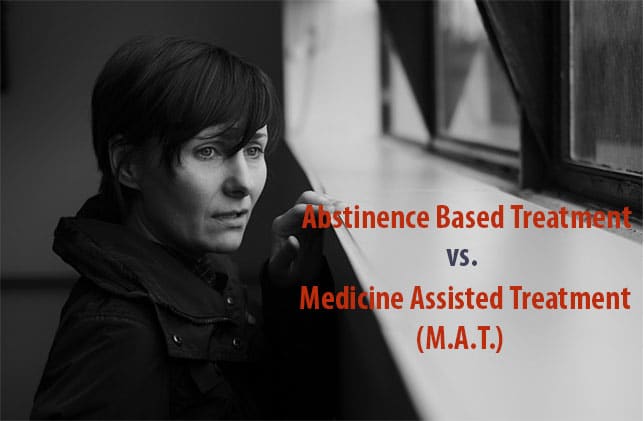
Abstinence Based Treatment vs. Medication Assisted Treatment (M.A.T.)
A person suffering from opioid addiction or heroin addiction has options in considering what treatment approach to choose to fight their substance use disorder. While there is an heroin and opioid epidemic and communities, legislatures, and medical communities are working hard to find ways to help those struggling. There are essentially two treatment plans available that are proven to be effective. An addict may choose an abstinence based treatment plan, or a treatment service referred to as Medication Assisted Treatment (or M.A.T.) Abstinence Based Treatment vs. Medication Assisted Treatment. Here is more information on each of these treatment plans.
Abstinence Based Treatment
Obviously, Abstinence Based Treatment plans have no use of medications. Addicts decide to go “cold turkey” to fight their addiction. Many believe that giving a drug (a crutch) to treat a drug addiction is not a way to fight drug addiction. You are just simply choosing one drug over another to fight the problem. It is also believed that the patient needs to develop inner and outer resources to cope with withdrawal from the drug of choice, cravings of the drug, and the every day happenings of life.
Therefore, those who go without medicine usually enroll in support environments such as Alcoholics Anonymous and/or Narcotics Anonymous. There is a 12 step program to conquering the drug abuse and there are many who have found this treatment to be effective and successful. Counselors are typically not doctors, but are former addicts who have successfully completed these substance abuse treatment programs and are now living sober, full lives.
 Medication Assisted Treatment of Opioid Use Disorder
Many believe that Abstinence Based Treatment is outdated for opioid use disorder and heroin addiction. As a commonly accepted practice, psychiatric and medical conditions are treated with medications. Especially relevant, Medication Assisted Treatment was a key part of the Obama Administrations plan to fight opioid addiction. The goal of addiction is recovery; a life without the misuse of drugs, alcohol, or medications.
For many opioid and heroin addicts, the withdrawal symptoms and cravings are more than they can tolerate. Methadone, Buprenorphine, and Vivitrol are common medications administered to the opioid or heroin addicted patient.
Methadone
Used for decades to treat heroin and opioid addiction. Methadone is an opioid that can reduce or eliminate cravings and withdrawal symptoms without creating the “high” feelings. It can be habit forming and should only be taken as prescribed as issued by a licensed physician. When taken as prescribed, it is safe and effective. Average time a patient is on medication, 3-5 years.
Buprenorphine
A partial opioid prescription drug, sold under the brand name Suboxone. Buprenorphine treatment tricks the brain into thinking an opioid is in the body, suppressing or eliminating withdrawal and cravings. The medication is in tablet or film form. Suboxone treatment usually requires a clinic visit once a month to renew the prescription and get a drug test. When medication is no longer needed, it is slowly tapered off with usually no side effects. Suboxone may be habit forming. Medication should only be taken as directed by a physician.
Vivitrol
A non opioid based medication that negates the effect of opiates in the brain. Vivitrol reduces the cravings, so that patients can participate full in addiction treatment. The medication is given once a month by a physician as a shot. This drug is most effective during the first 3 months of recovery and is not addictive. The disadvantage of Vivitrol is a patient can’t take it until they have been heroin or opiate free for at least 2 weeks. Since some patients can’t take the withdrawal symptoms without medication help, this option is not available for everyone.
Opioid Treatment Programs are Available
Regardless of your view of abstinence vs. medication assistance, there are pros and cons to each. Many recovering addicts want to abstain from using medications in rehab and choose the abstinence based treatment program. However for others, substance abuse withdrawal symptoms can be unbearable and many addicts have been dealing with opioid dependence for so long, it is virtually impossible for them to even think about going “cold turkey”. They need the help that Medication Assistance Treatment gives them to get through detox and starting the road to recovery. Consider the addict’s age, resolve, health, length of addiction, finances, outside influences when choosing a course of action to fight addiction.
At New Day Recovery, we specialize in opioid addiction treatment, painkiller abuse and heroin addiction. We pride ourselves in creating individual protocols based upon a “whole-patient” treatment approach to provide you an opportunity for a life long recovery.
Call us today. Your call will be completely confidential and we can provide additional resources to help you decide which treatment option is right for you.

